
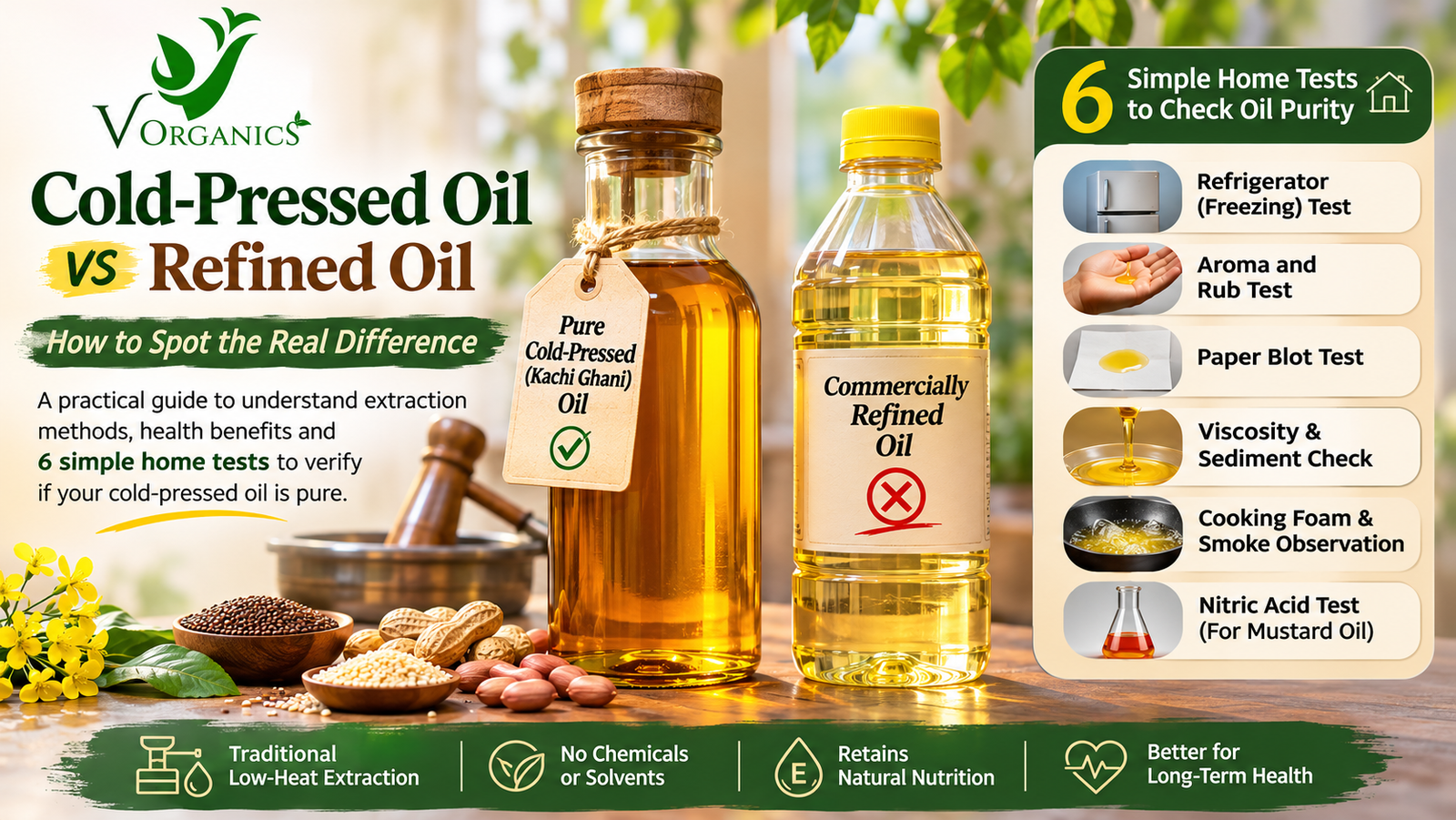
Cold-Pressed vs Refined Oil: How to Choose Pure Cooking Oil
Cooking oil goes into almost every Indian meal, from everyday tadka and parathas to deep-fried snacks. Labels such as "light," "pure," "heart-healthy," "Kachi Ghani" and "cold-pressed" make the choice harder, because some bottles match their claims and others are blends or heavily processed oils.
This guide explains how cold-pressed and refined oils differ, what to check before you buy, which popular home tests to ignore, and why only laboratory testing can confirm purity.
In short
- Read the ingredients, check the FSSAI licence and look for a batch number.
- Treat smell as a hint. Colour, sediment, refrigeration and foam prove nothing.
- Never try chemical tests at home.
- Only a laboratory report can confirm purity, so ask for the batch certificate of analysis.
1. How cold-pressed and refined oils are made
Extraction and processing affect an oil's colour, aroma, flavour and cooking behaviour.
Cold-pressed or wood-pressed oil (Kachi Ghani) is extracted mechanically by pressing oilseeds without deliberately applying external heat, and is then usually settled and filtered. Friction during pressing can add some heat, so "cold-pressed" does not mean one exact temperature. Many Kachi Ghani oils sold today are pressed in steel expellers rather than traditional wooden ghanis, so check how the producer defines its process.
Commercially refined oil may come from pressing, solvent extraction (commonly with hexane) or both. Refining then typically includes:
- Degumming: removes phospholipids and other impurities.
- Neutralisation: reduces free fatty acids.
- Bleaching: removes pigments and certain impurities.
- Deodorisation: uses steam under vacuum at high temperature to remove odours and flavours.
| Feature | Cold-pressed oil | Refined oil |
|---|---|---|
| Extraction | Mechanical pressing | Mechanical or solvent extraction |
| Processing | Usually settling and filtration | Multiple refining stages |
| Colour | Varies with seed and filtration | Usually lighter and more uniform |
| Aroma | Usually keeps the seed's natural aroma | Generally neutral |
| Minor compounds | May retain more | Some are reduced |
| Fatty acid profile | Depends on the seed | Broadly similar to the source oil |
| Smoke point | Varies, generally lower | Varies, generally higher for comparable oils |
Refined oil is not the same as adulterated or unsafe oil. Refining is a legitimate food-processing method. Adulteration means mixing, substitution or mislabelling, and it is a separate problem.
2. What to check before you buy
These checks take a minute and cost nothing. They are the most useful steps available to a shopper.
- Read the ingredients. A single-seed oil should name that oil, for example "cold-pressed groundnut oil." If the bottle contains more than one oil, the list must say so.
- Verify the FSSAI licence. Find the licence number on the pack and look it up on FSSAI's official licence verification portal (FoSCoS). Be wary of a missing or unverifiable number.
- Look for a batch number and manufacturing date. These make the product traceable if there is ever a problem.
- Check the packaging. Light, heat and oxygen degrade oils rich in unsaturated fats, so dark glass or opaque packaging protects quality better than clear containers.
- Read certifications correctly. India Organic (NPOP) and USDA Organic cover how the crop was grown and handled. They do not prove that an oil is free of adulteration.
- Smell the oil. Cold-pressed oils usually keep the aroma of the seed: roasted groundnut, toasted sesame, coconut or sharp mustard. A rancid, musty or chemical smell points to oxidation, poor storage or a quality problem. A neutral smell alone proves nothing, because aroma also depends on seed quality and filtration.
- Ask for a certificate of analysis. A credible producer should be able to show batch-level laboratory results.
3. Home tests that do not work
Colour, clarity, sediment, refrigeration and foam are often described online as purity tests. None of them can tell you whether an oil is genuine.
- Colour and clarity: natural colour varies with seed, extraction and filtration. A clear oil is not necessarily refined, and a cloudy or sedimented oil is not necessarily pure.
- Refrigeration: oils solidify or turn cloudy according to their fatty acid make-up. Coconut oil solidifies, groundnut oil may cloud, and mustard and sesame oils may thicken. Refined and cold-pressed oils can both do this, so the test cannot separate them.
- Foam and smoke in the pan: foam usually comes from moisture, food residue or oil that has been heated repeatedly. Unrefined oils naturally smoke at lower temperatures than refined ones, and Kachi Ghani mustard oil is traditionally heated before use to mellow its pungency.
If an oil seems wrong, trust the label checks above and the laboratory route below.
4. Why you should never try chemical tests at home
Mustard oil adulterated with argemone oil is a serious food safety risk. Argemone contains toxic alkaloids and has been linked to outbreaks of epidemic dropsy in India. Some traditional screening methods use concentrated nitric acid, which is highly corrosive and gives off dangerous fumes. Never attempt nitric acid tests or other hazardous experiments at home.
If you suspect an oil is adulterated:
- Stop using it.
- Keep the bottle and packaging.
- Note the batch number and manufacturing details.
- Report it through FSSAI's Food Safety Connect channels or your local Food Safety Officer.
- Ask an FSSAI-notified or NABL-accredited food testing laboratory about testing a sample. Laboratories usually charge a fee, so ask for the price and the parameters tested first.
5. Which oil for which cooking method?
There is no single smoke point for every mustard, groundnut, sesame or coconut oil. It depends on composition, refining, freshness and storage, so follow the manufacturer's guidance. As a general rule, unrefined oils smoke at lower temperatures than refined ones.
- Cold-pressed oils suit tadka, sauteing, shallow frying, dressings and any dish where you want the oil's flavour.
- Refined oils suit deep frying and other high-temperature cooking, or recipes that need a neutral flavour.
Whichever you use, avoid overheating the oil and do not keep reusing oil that has darkened or smells off, as repeated heating causes oxidation and undesirable breakdown products.
6. Frequently asked questions
Why is my cold-pressed oil cloudy or does it have sediment?
Oils that are only settled and filtered can keep small amounts of natural particles and waxes. This is normal, but it does not prove the oil is genuine. A clear cold-pressed oil is also possible.
Is refined oil unsafe?
No. Refined edible oils are legal food products when made to applicable food safety standards. Refining removes some impurities and reduces some minor compounds, while the main fatty acid profile stays broadly similar. The better choice depends on your cooking and overall diet. If you have a health condition, ask your doctor or dietitian.
Is mustard oil healthy?
Mustard oil is a traditional cooking oil in many Indian homes with a distinctive flavour. Traditional Indian mustard oil is naturally high in erucic acid, commonly cited at 40% to 54% of its fatty acids, which is far above the 2% to 5% limits some other regulators apply. FSSAI's standards separately define a low-erucic-acid rapeseed or mustard oil category capped at 2%. We could not find a clear FSSAI upper limit for conventional mustard oil, so confirm the current rule with FSSAI before quoting a number. Buy only from licensed sellers, and ask your doctor if you have concerns about how much to use.
Why is cold-pressed oil more expensive?
Pressing without solvent extraction can recover less oil from a given quantity of seed, depending on the seed and equipment. Seed quality, organic certification, production scale, filtration, packaging, testing and traceability also add to the cost.
How can I be sure my oil is pure?
Only appropriate laboratory testing can confirm it. A credible producer should provide batch identification and a certificate of analysis.
What is the difference between wood-pressed and cold-pressed oil?
Cold-pressed describes mechanical extraction without deliberately applied external heat. Wood-pressed usually means a traditional wooden ghani was used. Actual conditions depend on the equipment and producer, so check the producer's stated method.
Does organic certification guarantee purity?
No. It verifies organic production and handling. It does not replace testing for adulteration or contaminants.
7. How we test our oils at V Organics
V Organics Products LLP makes organic Cold Pressed Oils from certified organic Indian seeds. Our quality programme covers sourcing, seed handling, extraction, filtration, packaging and batch traceability, with laboratory testing for parameters such as purity, peroxide value and residues, as applicable to each product.
Each bottle carries a QR code that links to its batch laboratory report. Final thoughts
Choose oil on how it was made and what can be verified, not on front-label claims. Read the ingredients, check the FSSAI licence, ask for batch test results, and store and use oil responsibly, whether it is cold-pressed or refined.